Call us now :+918500019494
 Send Inquiry
RO Water Plant
120000 INR/Piece
Product Details:
- Technology Reverse Osmosis (RO)
- Feature High efficiency, Easy operation, Low maintenance
- Pump Type Centrifugal / Booster Pump
- Efficiency (%) 95-99%
- Water Out Conductivity < 20 S/cm
- Frequency 50 Hz
- Ph Level 6.5-8.0
- Click to View more
X
RO Water Plant Price And Quantity
- 120000.00 - 170000.00 INR/Piece
- 1 Piece
- 120000 INR/Piece
RO Water Plant Product Specifications
- 500 to 10,000 LPH
- 500-10,000 LPH (Liter per Hour)
- Floor Mounted
- Automatic
- Industrial and Commercial Water Purification, Drinking Water Supply
- 2-5 kW (Depending on model)
- Low Noise Operation
- Up to 99%
- Up to 70%
- Electric Motor
- Customizable as per requirement
- RO Water Purification System
- 6.5-8.0
- < 2000 S/cm
- Borewell, Municipal, Ground Water
- < 20 S/cm
- Stainless Steel (SS), FRP
- 50 Hz
- Multi-stage (Sediment, Carbon, RO Membrane)
- 95-99%
- 220-415 V, 50 Hz
- Electric
- High efficiency, Easy operation, Low maintenance
- Centrifugal / Booster Pump
- Reverse Osmosis (RO)
- Available (Sand, Carbon, Micron Filters)
- Microprocessor / PLC Based
- FRP/SS
- Stainless Steel / Painted MS
- Optional
- Manual / Auto
- >96%
- Up to 500 ppm
- DOW / Hydranautics / Equivalent
- 8-15 kg/cm²
RO Water Plant Trade Information
- 100 Piece Per Month
- 3 Days
- South India
- ISO
Product Description
RO Water Plant
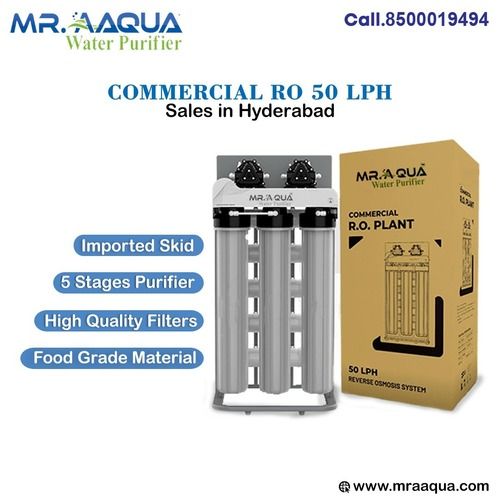
Shrini Water Purifiers is an upcoming name in the business of RO Water Plant with 500LPH, 1000LPH, 2000LPH and 5000LPH RO Water Plant at industry leading price with best quality Water Plant Spare Parts. Known for their excellent capacity, the proposed Water plants are optimum for pump foundations and raw water storage Plastic tanks. Due to the ease of installation, less floor space and excellent capacity of 1000 liters per hour RO Water Plant, our plants are widely welcomed.
RO Water Plant Special Features:
- World Class quality Water Plant Parts
- CRI Pumps
- Food Grade SS Storage Tank
- Experienced Team
- Supreme efficiency
- Lengthy operational life
- Require very less maintenance
| Application Purpose | Water Purification |
| Plant Brand | GES |
| RO Water Plant Capacity | 1000 LPH |
| Plant Application | Industrial RO & Mineral Plant |
| Plant Operation Mode | Semi-Automatic |
| Types Of Parts | Reverse Osmosis Unit, Multi-Grade Filter, Activated Carbon Filter, Membrane, Jumbo Filter |
| Number of Membranes in RO Plant | 1 |
| Material of Construction | FRP or SS, SS Powder coating |
| Max Water Recovery Rate | 50-55 % |
| Number of Filtration Passes | >5 |
| Voltage | 380 V |
| Frequency | 50 Hz |
| Power Source | Electric |
| Power Phase | Three Phase |
Advanced Multi-stage Filtration
This RO Water Plant integrates sand, carbon, and micron filters in a robust multi-stage filtration system. Supported by a pre-treatment unit, contaminants such as suspended solids, odors, and organic impurities are effectively removed, maximizing the performance and longevity of the RO membranes. This ensures cleaner water output and minimizes maintenance frequency.
Efficient Water Purification Technology
With DOW, Hydranautics, or equivalent brand membranes, the system operates at 8-15 kg/cm2 pressure and achieves TDS rejection rates exceeding 96%. The result is highly purified water with conductivity below 20 S/cm and a purity level reaching up to 99%. Optional chlorine dosing and recycle rates up to 70% enhance resource conservation and water quality.
Flexible Design & Reliable Operation
The plant is modular and customizable, allowing installation in various industrial or commercial settings. Constructed from durable stainless steel and FRP, it is available with automatic or manual discharge options. The advanced microprocessor or PLC control panel ensures user-friendly operation, low noise, high reliability, and minimal operational complexity.
FAQ's of RO Water Plant:
Q: How does the RO Water Plant ensure effective removal of impurities?
A: The plant utilizes a multi-stage pre-treatment unit with sand, carbon, and micron filters to eliminate suspended particles, organics, and chlorine before reverse osmosis. The RO membrane then achieves over 96% TDS rejection, delivering water with less than 20 S/cm conductivity and up to 99% purity.Q: What types of water sources can the RO Water Plant treat?
A: This system is designed to purify water from borewell, municipal, and groundwater sources. Its robust filtration and membrane technology ensure reliable performance across diverse water quality challenges.Q: When should the chlorine dosing system be used with the RO Water Plant?
A: The optional chlorine dosing system is recommended when treating raw water with higher organic or microbial content, as it disinfects and protects the membranes from biofouling. Its usage depends on specific water quality and operational requirements.Q: Where is the RO Water Plant suitable for installation?
A: It is suitable for industrial and commercial settings where large volumes of purified water are required, such as factories, offices, hospitals, and institutions. The floor-mounted design allows flexible positioning in these environments.Q: What is the process for water purification in this plant?
A: Water initially passes through sand, carbon, and micron filters in the pre-treatment unit. It then enters pressure vessels housing high-quality RO membranes, where dissolved solids are removed under high pressure. Optionally, chlorine dosing may be used before or after RO, and purified water is collected for use.Q: How does the system benefit users in terms of maintenance and efficiency?
A: The plant features high-efficiency pumps, automated control panels, and low-noise operation. Its design ensures reduced downtime and minimal maintenance needs, providing reliable water quality and substantial savings in energy and operational costs over time.Q: What applications is the RO Water Plant commonly used for?
A: This system is ideal for industrial and commercial water purification in manufacturing, drinking water supply, food processing, and institutions requiring consistent, high-purity water at flow rates from 500 to 10,000 LPH.Tell us about your requirement

Price:
Quantity
Select Unit
- 50
- 100
- 200
- 250
- 500
- 1000+
Additional detail
Mobile number
Email

Other Products in 'RO Water Plant in Hyderabad' category


 Send Inquiry
Our Products

Beside ICICI Bank ATM, Papa Reddy Nagar, Near to Bus Stand, Jagathgiri Gutta, Kukatpally,Hyderabad - 500037, Telangana, India

Ms. Samatha V
(Proprietor)
Mobile :+919700537678, +919133031861, +918500019494
 Send Inquiry
 Send SMS
Developed and Managed by Infocom Network Private Limited.
